
The Great Exchange: 5 Radical Realities Beyond simple Tragedy

1. Introduction: The Problem of the “Old Version” of You
We all know the weight of the “old version” of ourselves—the one that keeps a meticulous tally of every missed opportunity, every broken promise, and every dark thought. It is the version of us that feels “stuck” in a cycle of bad decisions, convincing us that our identity is forever fused to our mistakes. On Good Friday, we often approach the cross as a somber historical tragedy, a moment to mourn a victim. But if we look closer, we find something far more radical. At a recent gathering, the narrative was reframed not as a funeral, but as a “Great Exchange.” It’s an event that promises to dismantle the old version of who you are and replace it with a reality that is as intellectually profound as it is personally transformative. This is the anatomy of a 2,000-year-old trade that still has the power to rewrite your modern identity.
2. The Cosmic Trade: Why Forgiveness Wasn’t Enough

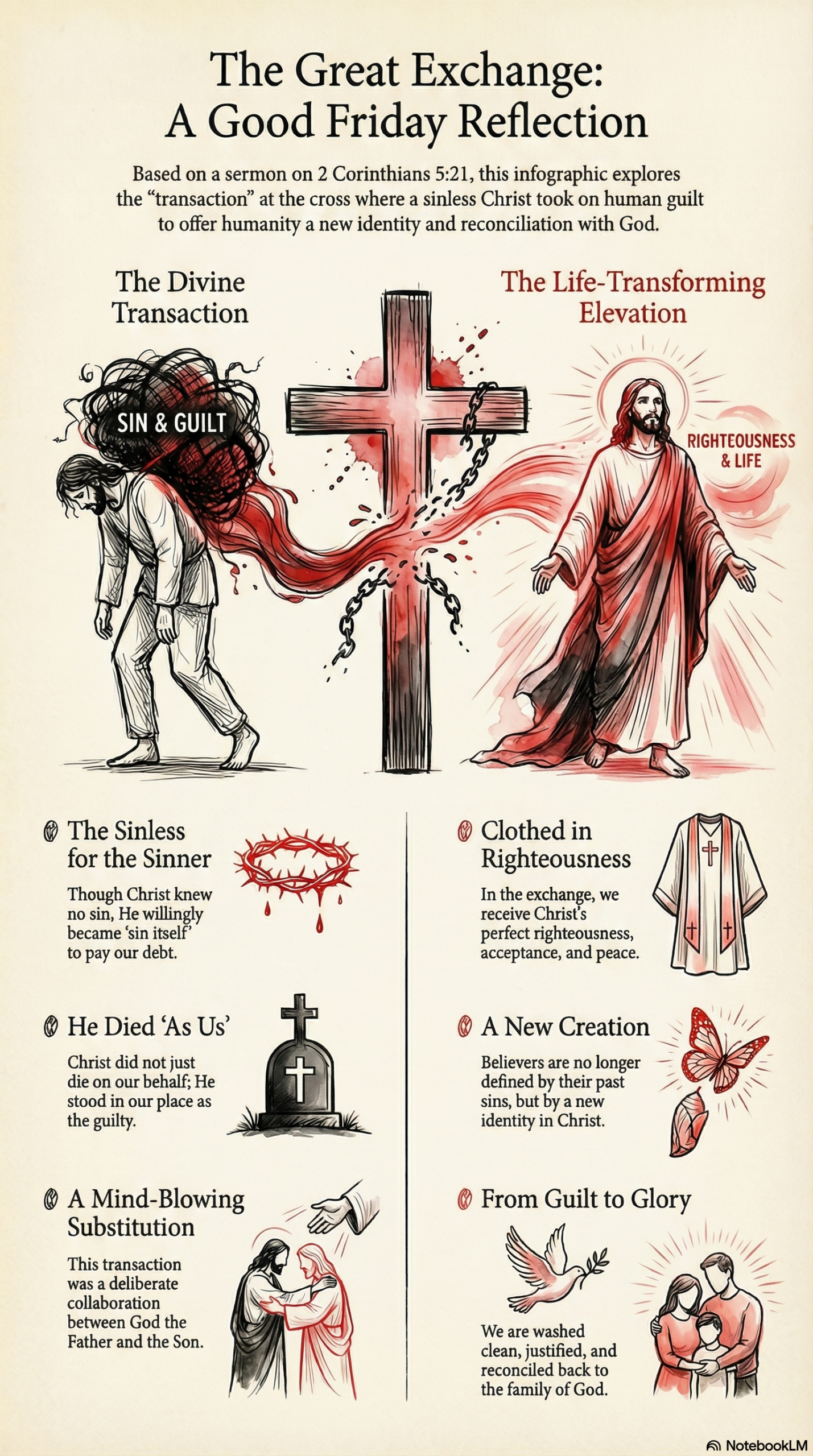
The core of this reality is found in 2 Corinthians 5:21, a verse that feels like the whole gospel distilled like a diamond under the pressure of eternity. Traditionally, we view the cross through the lens of simple forgiveness—Jesus “paying a debt.” But the source material suggests something deeper: a transaction of cosmic proportions. This wasn’t a last-minute rescue mission, but an “Informing Revelation” born from a divine consultation between the Father and the Son in eternity, long before the first chapter of Genesis was written. The Father initiated the redemption; the Son implemented it.
“At the cross, Jesus didn’t simply forgive us; he traded places with us. He became what we were so that we could become what he is.”
Jesus took what was ours—the sin, the guilt, the visceral shame—and in return, he handed us what was his: his righteousness, his acceptance, and his unshakeable peace with God.
3. The Distinction: The Mystery of Dying “As” Us
There is a subtle but massive distinction in the language of the cross that we often miss. Jesus did not merely die for us; he died as us. This “Mindblowing Substitution” meant that the sinless Son of God stepped into our exact legal and spiritual standing. In the Garden of Gethsemane, when Jesus looked into the “cup,” he saw sin distilled—every despicable act, every murder, every betrayal, and every dark deed ever committed. It was so repulsive to his holy nature that he initially asked if the cup could pass. Yet, he drank it to the dregs.
This trade was valid only because of the “Defining Attestation” of Jesus’ character: he was utterly sinless. This sinlessness wasn’t a footnote; it was the mechanics of the miracle. The spotless lamb became the essence of our sin so we could become the essence of his purity.
4. Identity Over Improvement: Beyond “Behavior Modification”

The result of this trade is a “Life Transforming Elevation.” The Great Exchange isn’t a divine self-help program or a prompt for better behavior; it is a fundamental shift in identity. As 2 Corinthians 5:17 notes, to be in Christ is to be a “new creation.” This is where the old version of you is legally and spiritually retired. This elevation means we are no longer defined by our efforts to be “better” people, but are instead invested with the righteousness of God. When the Father looks at you, he no longer sees your failures; he sees the perfection of his Son.
5. Your History is No Longer Your Definition
A primary “Resulting Implication” of this exchange is that your past—no matter how “vile or ugly”—is no longer your definition. We see the speed of this identity rewriting in the thief on the cross. In a single moment of turning to Jesus, he was transformed from a condemned criminal to a citizen of paradise. His “guilty state” was instantly traded for a “state of grace.”
“We are no longer defined by our past… although I had so many many sins, Jesus washed them all away.” — Adapted from the hymn of redemption.
Your history has been traded away. The stains are not just covered; they are gone.
6. The Weight of the Price: A New Kind of Loyalty
While the Great Exchange is a free gift, the only logical response is a life of “loyal commitment.” We don’t change our lives to earn the gift; we change because the debt has already been paid. Real internal change results in external life shifts that can seem radical to the outside world. We live differently because we have been made new, not because we are trying to satisfy a checklist.
7. Conclusion: Stepping Into the Finished Work
The Great Exchange is a finished work. It’s an open invitation to trade your heaviest burdens for a righteousness you could never earn. It’s the difference between struggling in the mud and being raised to a new life entirely. The invitation is to leave the “old you” at Calvary and step into the new creation you were intended to be.
Bible Verse References (ESV)
- 2 Corinthians 5:21 “For our sake he made him to be sin who knew no sin, so that in him we might become the righteousness of God.”
Hint: The foundational mechanism of The Great Exchange. - Galatians 3:13 “Christ redeemed us from the curse of the law by becoming a curse for us—for it is written, ‘Cursed is everyone who is hanged on a tree.'”
Hint: Highlighting that Jesus died AS us, taking our penalty. - 2 Corinthians 5:17 “Therefore, if anyone is in Christ, he is a new creation. The old has passed away; behold, the new has come.”
Hint: The fundamental shift in identity—you are legally retired from your old self. - Isaiah 53:5 “But he was pierced for our transgressions; he was crushed for our iniquities; upon him was the chastisement that brought us peace…”
Hint: The cosmic trade that purchased our unshakeable peace with God. - Matthew 26:39 “…’My Father, if it be possible, let this cup pass from me; nevertheless, not as I will, but as you will.’”
Hint: Jesus initially rejected the cup of concentrated sin, yet drank it.
SOURCE: The Great Exchange: How Jesus Traded His Righteousness for Your Sin, Rev. Dr. Gerry Gallimore


