
Stop Trying to Be Your Own Savior: 5 Impactful Lessons from the “Deliverance to Dependence” Journey

It is a paradox many of us know all too well: we are physically free, yet spiritually fearful. We celebrate our “Red Sea moments”—those grand, cinematic miracles where God breaks a chain of addiction or delivers us from a financial crisis—only to find ourselves trembling the moment the next bill arrives or a new conflict flares up. The transition from being delivered by God to actually depending on Him daily is the messy, glorious middle of the Christian walk. Inspired by the sermon series Deliverance to Dependence, let’s explore five vital lessons on how to stop trying to be our own savior and start leaning on the only One who can actually carry the weight.
1. The “Pat on the Back” Trap: Understanding Your History
True appreciation for deliverance is impossible if we minimize the severity of what we were saved from. We often fall into a subtle state of self-righteousness, assuming God’s grace was a reward for our potential rather than a rescue from our ruin. To understand the weight of grace, we must first understand the weight of the sin that preceded it.
“If I put 800 lbs on a dead body, will he feel it? No. You’ll never know the significance of the gospel and salvation if you don’t know how severe your condition really was.”
2. The 31-Day Amnesia: Navigating Deliverance to Dependence
There is a strange phenomenon in the human heart where we remember the wrong things. We must remember our depravity to appreciate grace, yet we often choose to remember the “comforts” of our past life instead of God’s current provision. It is often easier to trust God for a one-time breakthrough than for daily maintenance. Grumbling is rarely a resource issue; it is a trust issue.
3. The “Not Good” of the Solo Hustle
In Exodus 18, we see Moses acting as a total “tryhard” by attempting to judge the disputes of millions alone. His father-in-law, Jethro, offers a blunt, necessary critique: “What you are doing is not good.” Independence is often just a mask for pride or deep-seated insecurity. We are designed for shared burdens, not isolated exhaustion.
“If you want to go fast, go alone. If you want to go far, go with others.”
4. Manna and the Strategy of Deliverance to Dependence

When God provided Manna, the instruction was surgical: gather only a “daily portion.” The instinct to hoard was a physical manifestation of spiritual distrust—a fear that God might not show up tomorrow. This physical provision points us toward Jesus, the true “Bread of Life.” Every morning requires a fresh encounter; we cannot store up yesterday’s grace for today’s battles.
5. Fighting From Victory, Not For It

The battle against the Amalekites provides the ultimate blueprint for spiritual warfare. It wasn’t won through military genius alone, but through prayer. This victory led to the revelation of God as Jehovah Nissi—The Lord is my Banner. When we fight under His banner, we realize we are not fighting for a victory that is in doubt; we are fighting from a victory already secured.
“Jehovah Nissi fights your battles… the Lord is undefeated.”
Conclusion: From Breakthrough to Abiding
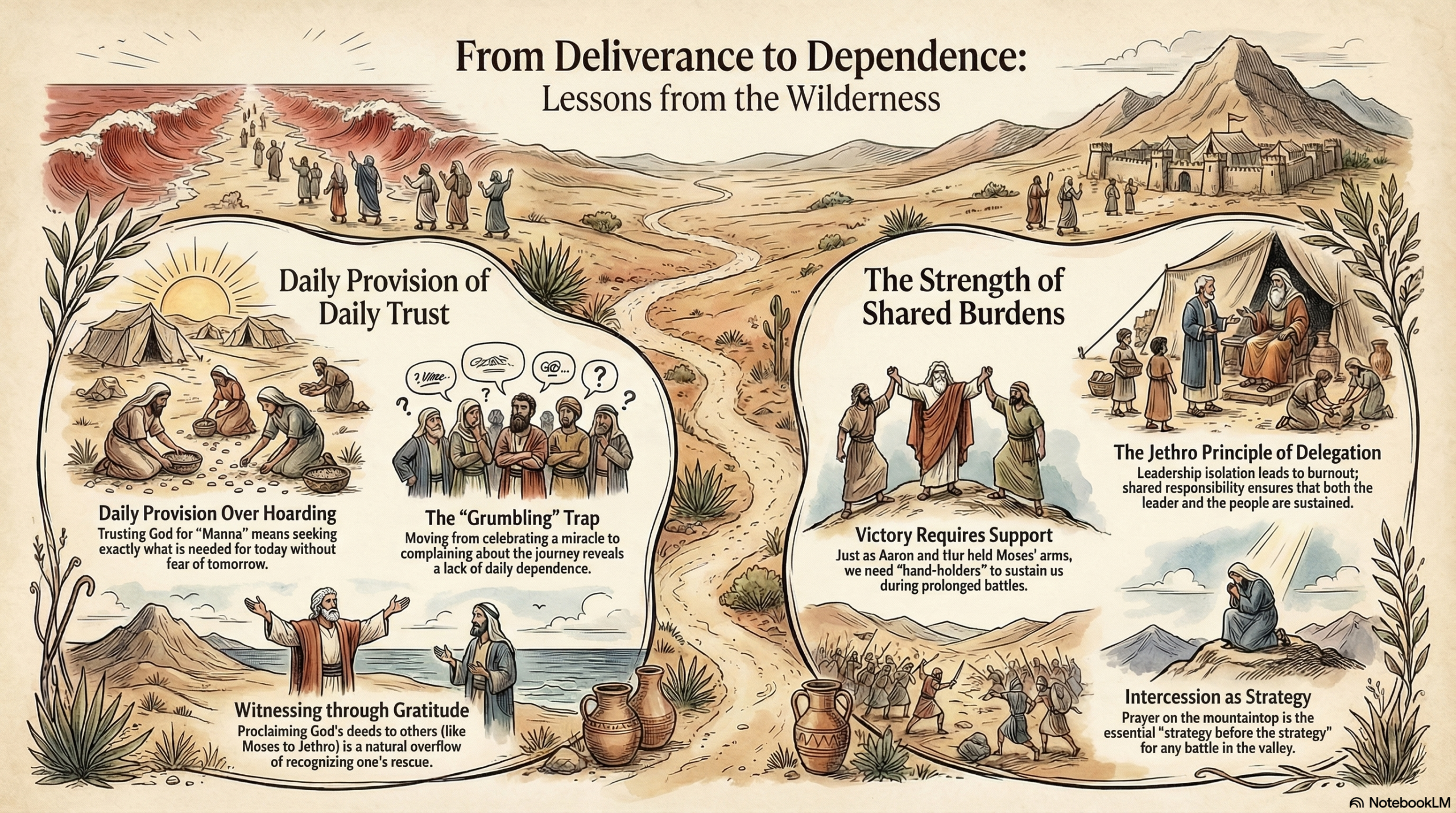
The journey of Deliverance to Dependence is the shift from a one-time event to a lifelong posture of abiding. God provides exactly what is needed for the next twenty-four hours—and that is more than enough.
Bible Verse References (ESV)
- Exodus 14:13 – “Fear not, stand firm, and see the salvation of the Lord.”
Hint: The initial moment of deliverance at the Red Sea. - Exodus 16:2-3 – “And the whole congregation of the people of Israel grumbled against Moses…”
Hint: The reality of “31-day amnesia” and the struggle to trust God for daily bread. - Exodus 18:17-18 – “Moses’ father-in-law said to him, ‘What you are doing is not good. You and the people with you will certainly wear yourselves out.'”
Hint: A biblical warning against the “solo hustle” and isolated leadership. - John 6:35 – “Jesus said to them, ‘I am the bread of life; whoever comes to me shall not hunger…'”
Hint: Connecting the physical Manna of the wilderness to the eternal satisfaction found in Christ. - Exodus 17:15 – “And Moses built an altar and called the name of it, The Lord Is My Banner.”
Hint: The revelation of Jehovah Nissi as the source of victory through dependence.