
The Long Road Home: Finding Hope in the Unexpected Places of Christmas

The holiday season is often painted with a specific aesthetic: the golden glow of string lights, the aroma of a home-cooked feast, and the comforting noise of a full house. Yet, for many of us, the reality of December feels quite different. Finding home at Christmas can feel impossible beneath the festive surface, where there is often a profound sense of displacement—a lingering grief over an empty seat at the table, the ache of loneliness in a crowded room, or the feeling of being “far from home” even when you are standing in your own living room.
The Christmas story is frequently reduced to a cozy historical narrative, but it is actually a staggering promise of a “forever home.” It is an invitation to move beyond temporary dwellings—those buildings we rent or own for a season—and find our place in a kingdom of belonging that transcends any physical location.
1. Home is a Person, Not a Place when Finding home at Christmas
We often associate “home” with a specific feeling or a certain zip code. However, the true essence of home is found in a relationship, not a structure. There is a breathtaking mystery at the heart of this story that theologians call the Hypostatic Union. It is the staggering reality of God wrapping Himself in human flesh—a child born in all His humanity, yet a Son given in all His deity.
Because Jesus took on the weight of our humanity, He understands the grit of our lives—our hunger, our exhaustion, and our deepest fears. He didn’t just look down at us; He became one of us.
“Home isn’t a feeling. Home is a person. And that person is Jesus.”
For anyone feeling displaced or like an orphan of circumstance this season, the promise is simple: Home is wherever He is. You are no longer searching for a destination; you are being welcomed by a Person.
2. Inconvenience is Not Absence When Finding Home at Christmas

When we encounter difficult or unexpected circumstances, our first instinct is to assume God has stepped out of the room. We see Mary and Joseph’s journey to Bethlehem through a sanitized lens, but the reality was far more grueling. Imagine a nine-month-pregnant woman traveling 80 to 90 miles from Nazareth to Bethlehem. With no modern comforts, this was a journey of callous hands and tired feet, undertaken with the heavy boot of the Roman Empire on the neck of hope.
To Joseph and Mary, the census decree by Caesar Augustus likely felt like a massive, secular interruption to their lives. Yet, this political inconvenience was actually a divine direction. It was the necessary detour toward their destiny, fulfilling a 700-year-old promise. They were building a life out of sawdust, breadcrumbs, and grace, unaware that the road that felt like a burden was actually the path to the promise.
“It was 90 miles of dust and doubt.”
If your life feels interrupted right now, remember that a difficult road is often the very mechanism God is using to bring you to the place where the promise is fulfilled. Inconvenience is not evidence of God’s absence; it is often the evidence of His movement.
3. From Visitation to Habitation

One of the most powerful shifts in the Christmas story is found in the word “dwelt.” When the Word became flesh and dwelt among us, the original language implies that God “tabernacled”—He literally pitched His tent in our camp.
In the ancient world, a visit was a temporary courtesy. But God did not come for a brief visitation; He came for a permanent habitation. He chose to “move in” to the human experience. It is a beautiful subversion of our expectations that He didn’t choose a pristine palace or a hospital with modern aromatherapy. Instead, He chose the “humble side of town” and a feeding trough thick with animal odor. By choosing the manger over the mansion, God proved that He is not a distant deity shouting from the heavens, but a Father who draws near to the broken and the overlooked.
4. Prophecy is a Future Fact When Finding Home At Christmas
We often treat ancient prophecies as sentimentality, but the biblical narrative anchors our hope in history. Fairy tales begin with “once upon a time,” but the Christmas story begins with “in those days”—placing it firmly amidst real governors, specific decrees, and historical tax brackets.
The census of Caesar Augustus was not a random political event; it was the tool God used to ensure Jesus was born in Bethlehem, exactly as Micah 5:2 and Isaiah 7:14 predicted seven centuries earlier. This teaches us that prophecy is not a “fairy tale” hope; it is a “future fact.” If God kept His specific, humble promises during the first Christmas, we can stand firmly on His word for our own futures today. Our hope is not based on a feeling, but on the proven track record of a God who manages history to keep His word.
5. The “Mighty God” in the Manger
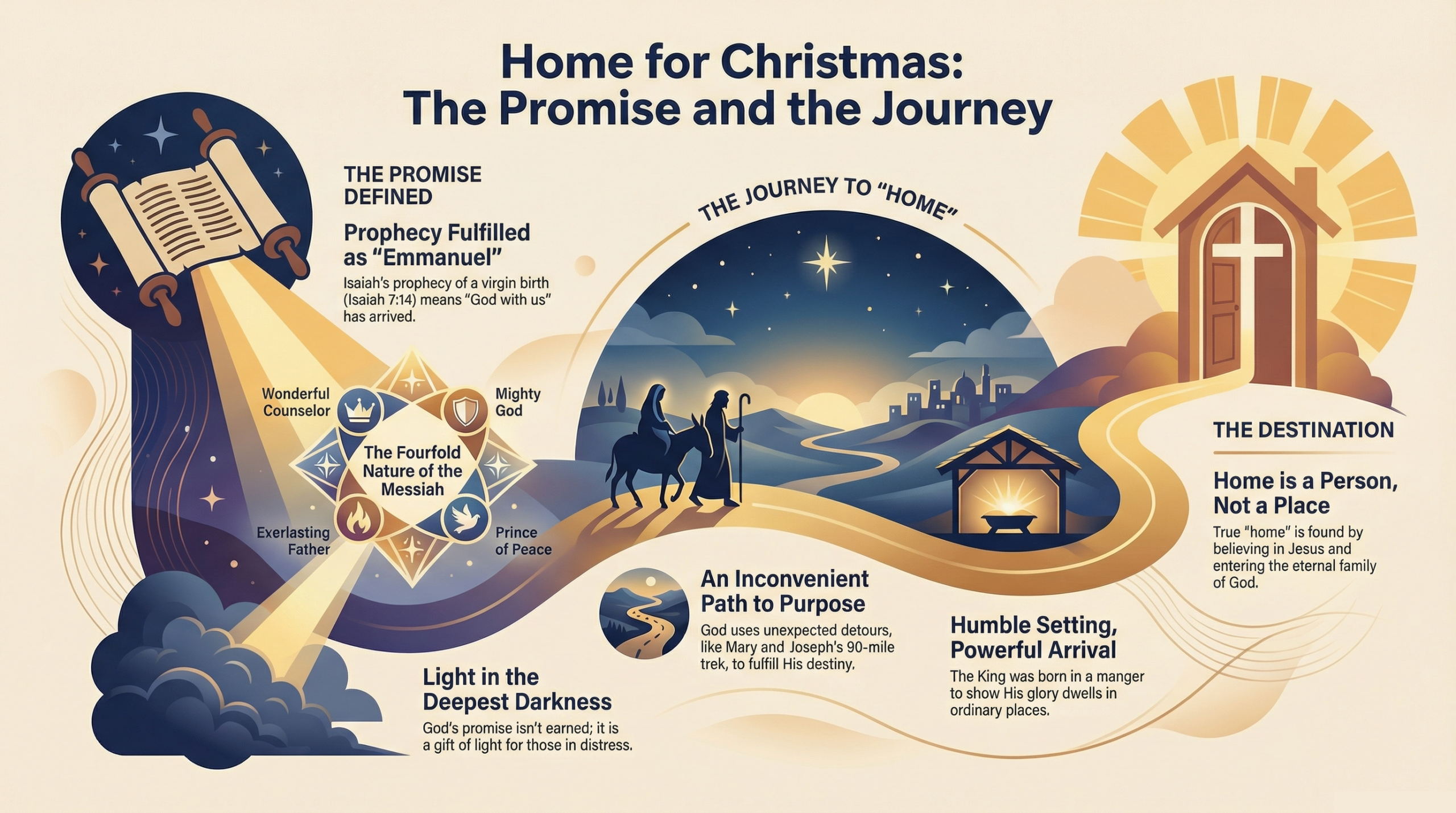
In Isaiah 9:6, we are given four names for the child in the manger that act as a roadmap for the human soul:
- Wonderful Counselor: For when we are confused and need a guide who goes beneath the surface of our circumstances.
- Mighty God: For our salvation, possessing the power to rescue us when we cannot rescue ourselves.
- Everlasting Father: For those who feel abandoned, offering a fatherhood that will never fade or forsake.
- Prince of Peace: For the war within, reconciling the enmity between our hearts and the Divine.
There is a profound irony in the “Mighty God” entering the world with a first breath in a barn. The God who “shattered the rod of the oppressor” chose to arrive in the hush of human weakness. He entered our fragility so that we could finally participate in His strength.
Conclusion: Making Room When Finding Home At Christmas
The journey of life is undeniably hard. It is filled with peaks, valleys, and roads we would never choose for ourselves. Yet, the arrival of the Savior means that “home” has already arrived. You don’t have to strive or work your way into the family of God; you simply have to receive the Person who is the promise.
As we move through the noise of this season—the shopping, the stress, and the expectations—let us look past the temporary lights toward the eternal one. In a world that is filled to the rafters, the question remains for each of us:
“In a world that is filled to the rafters, have you made room for the promise?”
SOURCE: Home for Christmas Sermon Series, Pastor Arthur Connor Jr
Supporting Bible Verses
John 1:14 (ESV) “And the Word became flesh and dwelt among us, and we have seen his glory, glory as of the only Son from the Father, full of grace and truth.”
Hint: This verse emphasizes God literally “tabernacling” or pitching His tent to live among humanity.
Hebrews 4:15 (NIV) “For we do not have a high priest who is unable to empathize with our weaknesses, but we have one who has been tempted in every way, just as we are—yet he did not sin.”
Hint: Jesus understands the “grit” of human life because He experienced it fully.
Luke 2:1-5 (NIV) “In those days Caesar Augustus issued a decree that a census should be taken of the entire Roman world… So Joseph also went up from the town of Nazareth in Galilee to Judea, to Bethlehem the town of David…”
Hint: The historical account of the difficult political journey that led Mary and Joseph to Bethlehem.
Micah 5:2 (NIV) “But you, Bethlehem Ephrathah, though you are small among the clans of Judah, out of you will come for me one who will be ruler over Israel, whose origins are from of old, from ancient times.”
Hint: The specific 700-year-old prophecy pinpointing the exact location of the Messiah’s birth.
Isaiah 9:6 (NIV) “For to us a child is born, to us a son is given… And he will be called Wonderful Counselor, Mighty God, Everlasting Father, Prince of Peace.”
Hint: The prophetic names of Jesus that act as a roadmap for the needs of the human soul.


