
No products in the cart.
Beyond the Pearly Gates: Why Your Idea of “Heaven” Might Be Backwards

For decades, modern Christendom has been dominated by an “exit strategy” theology. We have inherited a narrative of abandonment—an unintended consequence of focusing so intently on the “after” that we ignore the “here.” We treat Earth as a temporary, broken lobby, while we wait for an evacuation to a distant, celestial realm. However, a rigorous look at the biblical narrative suggests this escape mentality is actually at cross-purposes with the biblical Kingdom of God and the Creator’s overarching plan. The goal was never to leave this world behind, but to witness its reclamation.
The Earth is the End Goal, Not Heaven
The prevailing cultural assumption that the “goal” of faith is the permanent relocation of the soul to heaven contradicts the consistent theological architecture of Scripture. From Genesis to Revelation, the narrative arc does not point toward an escape from matter, but the restoration of it. God’s primary interest is not a celestial evacuation, but the localized reign of the biblical Kingdom of God on a physical Earth.
God’s ultimate aim is not for your soul to go to heaven, but for his kingdom to come to earth.
The “Temple” We Forgot—Eden as the First Sanctuary

To grasp the future of the planet, we must recover the lost identity of the Garden of Eden. Eden was not merely a primitive park; it was the original Temple, the localized dwelling place of God on the earth. The theological weight lies in the “priestly verbs” used to describe Adam’s mandate: to “work” and “keep” the garden. This implies that our “secular” labor was originally intended as a priestly act within the biblical Kingdom of God.
The Symmetry of Redemption—From Garden to Garden – Biblical Kingdom of God
There is an evocative redemptive symmetry between the first act of rebellion and the moment of resurrection. The fall occurred in a garden, and consequently, the act that reversed this rebellion also took place in a garden—the garden tomb where Christ was laid.
As Adam brought death to himself… from the midst of a garden, Christ was raised and brought life… from a grave in the midst of a garden.
“Making All Things New” vs. “Making All New Things” – Biblical Kingdom of God

A common theological error is the belief that God intends to discard the current universe and replace it with entirely new material. However, the Greek linguistic nuance in Revelation suggests a “qualitative” renewal.
He doesn’t say, I am making all new things. But instead… I am making all things new.
The Fall of the “Throne Guardian”

The restoration of Earth is the conclusion of a cosmic legal battle for territory originally overseen by the adversary. The “serpent” of Genesis is described by Ezekiel as a “throne guardian cherub.” This cosmic struggle forms the crux of the book of Revelation, where the “ancient serpent” is finally cast down to make room for the biblical Kingdom of God and the human priesthood.
Conclusion: Our Glorious Homecoming – Biblical Kingdom of God
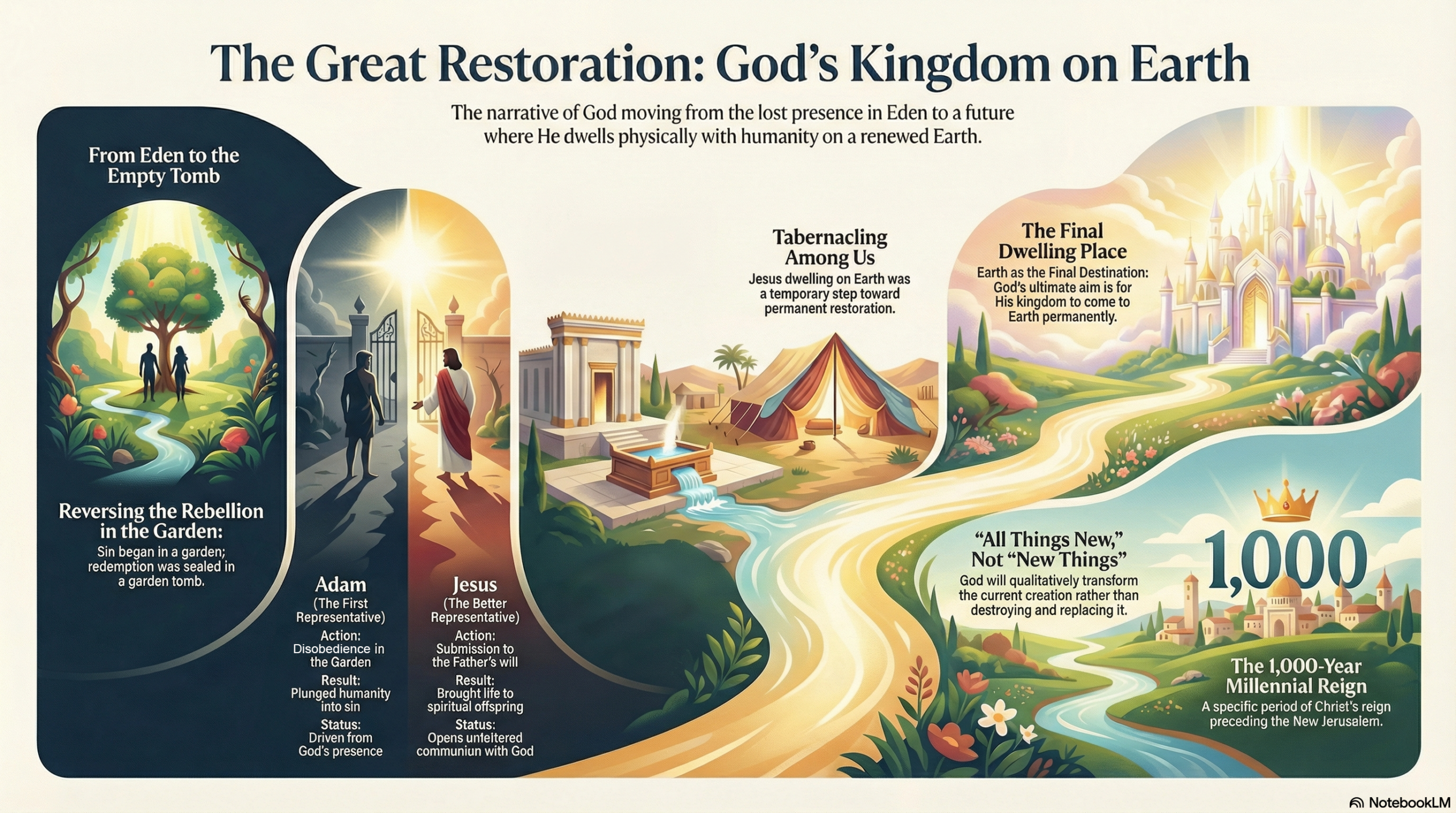
The biblical narrative does not culminate in a great escape, but in a grand arrival. We should not expect to spend eternity as disembodied spirits in a distant cloud; rather, we are invited to anticipate the biblical Kingdom of God taking root in a world made whole. Scripture promises a future where the King returns to finish what He started in the garden—a physical, tangible reality where “God’s dwelling place is now among the people” (Revelation 21:3).
Instead of viewing our current life as a waiting room, we should think of it as an apprenticeship for the world to come. Christ has in store for us a life of purpose, where our original mandate to “work and keep” the creation is finally realized without the sting of “disobedience in the garden” or the weight of the curse. We can expect a qualitative transformation where every broken atom is healed and every tear is wiped away by the True Gardener Himself. We aren’t just going to a place; we are participating in a reclamation project that spans the cosmos. When the New Jerusalem finally descends and the Earth is fully liberated, we will realize that we weren’t just looking for a way out—we were looking for the way home.
What A Day That Will Be!
Bible Verse References (ESV)
Revelation 21:1-5 “Then I saw a new heaven and a new earth… And he who was seated on the throne said, ‘Behold, I am making all things new.'”
Hint: Core text for the qualitative renewal of creation over total replacement.
Matthew 6:10 “Your kingdom come, your will be done, on earth as it is in heaven.”
Hint: Jesus’ primary prayer focus on the earthly arrival of the Divine reign.
Genesis 2:15 “The Lord God took the man and put him in the garden of Eden to work it and keep it.”
Hint: Establishes the original “priestly” mandate of humanity on earth.
Romans 8:19-21 “For the creation waits with eager longing for the revealing of the sons of God… that the creation itself will be set free from its bondage to corruption.”
Hint: Describes the earth itself awaiting redemption alongside humanity.
SOURCE: What a Day That Will Be! | Rev. Rodman Cory, Metropolitan Baptist Church


